21 August 2026
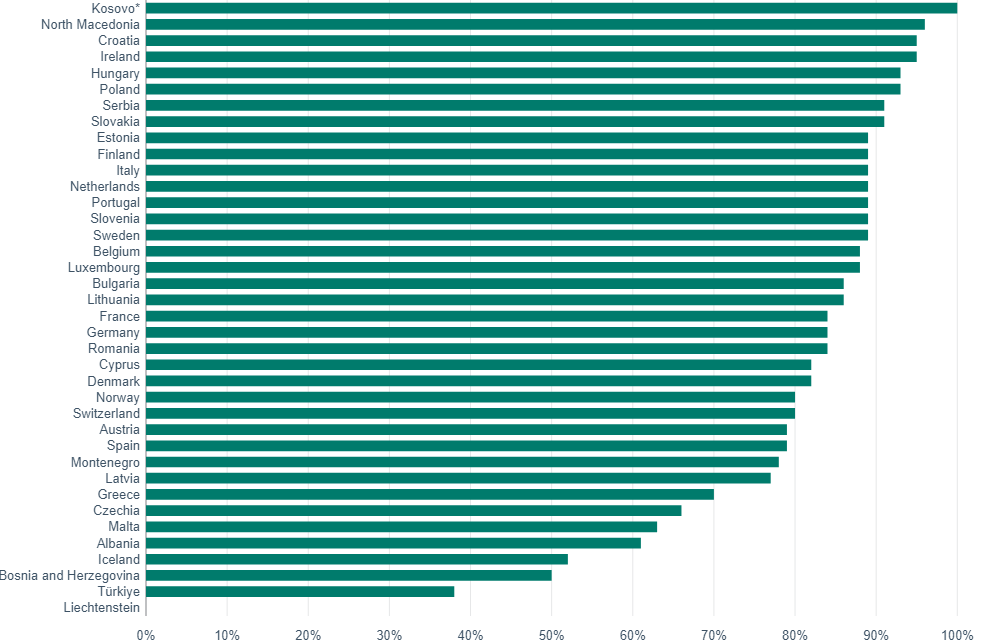
Kosovo has achieved an outstanding result in environmental reporting for 2025, fulfilling 100% of its obligations within the main EIONET data flows. This result places Kosovo as the only country to have achieved full fulfilment of its reporting obligations for 2025 and demonstrates the timely provision of high-quality data.
The European Environment Information and Observation Network (EIONET), within the framework of the European Environment Agency (EEA), assessed the fulfilment of reporting obligations by reporting countries for 2025. The assessment covers hundreds of datasets and measures countries’ performance in terms of timeliness and data quality.
In addition to Kosovo, seven countries – North Macedonia, Croatia, Ireland, Hungary, Poland, Serbia, and Slovakia – achieved a score of 90% or higher.
One of the key performance indicators, defined in the EEA-EIONET Strategy 2021–2030, is achieving an overall average reporting score of at least 90%. According to the assessment for 2024, this target was not fully achieved: the average reporting performance was 88% for the 27 EU countries and 85% for all EEA countries and cooperating countries.
For 2025 as well, Kosovo, through the data reported by the Kosovo Environmental Protection Agency (KEPA), received the maximum score in all mandatory reporting areas. These include:
This is the fifth consecutive year that Kosovo has achieved the maximum score in fulfilling its reporting obligations within EIONET. This success is the result of the work and dedication of KEPA experts, cooperation with other monitoring institutions at the national level, as well as continuous donor support through various projects.
This achievement demonstrates KEPA’s commitment to fulfilling its obligations within the framework of cooperation with the European Environment Agency (EEA) and the European Environment Information and Observation Network (EIONET), as well as to advancing the European integration process.
The assessment aims to measure countries’ progress according to agreed reporting criteria, particularly timeliness and data quality, enabling countries to identify and prioritize the resources needed for regular reporting processes.
Ensuring accurate, complete, and timely data through EIONET is essential for the EEA to fulfil its mission of providing policymakers and the public with reliable, relevant, and timely information on the state of the environment.
For more information: EIONET Data Flows for 2025